

















CANBERRA — The Albanese government has unveiled the largest peacetime expansion of defence spending in Australian history, committing tens of billions of dollars to nuclear submarines, warships, missiles, cyber warfare, and veterans’ services in response to a rapidly deteriorating strategic environment in the Indo-Pacific.
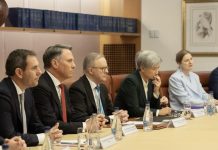
In a joint statement on Wednesday, Defence Minister Richard Marles and Defence Industry Minister Pat Conroy confirmed the 2026–27 federal budget delivers on the government’s new 2026 National Defence Strategy, adding an extra $14 billion over 4 years and $53 billion over the decade to defence outlays.
The government said the latest injection brings Labor’s total additional defence investment since taking office to $30 billion over the forward estimates and $117 billion over ten years.
Total defence portfolio funding — including the Australian Defence Force, Australian Signals Directorate, Australian Submarine Agency, and Australian Naval Nuclear Power Regulator — will reach $887 billion by 2035–36.
At the centre of the budget is a $425 billion, decade-long plan to build an “integrated, focused force” designed to boost self-reliance and strengthen deterrence in the Indo-Pacific.
Nuclear subs and naval expansion dominate
The largest single ticket item remains the AUKUS nuclear-powered submarine program, with billions allocated for infrastructure, workforce development, submarine construction, and nuclear stewardship. Major works will continue at Western Australia’s Henderson Defence Precinct and South Australian shipyards.
The government is also moving ahead with acquiring new General Purpose Frigates as part of a broader naval expansion.
The budget also flagged around 5 billion over 4 years and 15 billion over the decade — for projects where Defence will explore alternative financing, particularly for defence estates, Henderson, and guided weapons production.
Veterans and military welfare
Alongside capability spending, the government has set aside more than $770 million in response to the Royal Commission into Defence and Veteran Suicide which includes: $169.7 million over five years to raise allied health fees for veterans from July 2027, $29.8 million for a new National Veterans’ Data Asset and $16.6 million for an independent inquiry into military sexual violence in the ADF, beginning mid-2026.
The government said the spending would also support recruitment, with ADF enlistment at its highest level in more than a decade.
The budget also confirmed the establishment of a new Defence Delivery Agency from 1 July 2027, tasked with speeding up procurement and improving value for money on major defence projects.