













MANILA, November 18: Leaders of Australia, the United States, India and Japan have agreed to deepen strategic cooperation across the Indo-Pacific, unveiling new initiatives in maritime security, cybersecurity, artificial intelligence and regional infrastructure following a Quad summit in Manila.
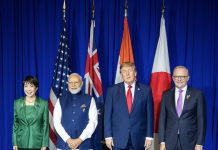
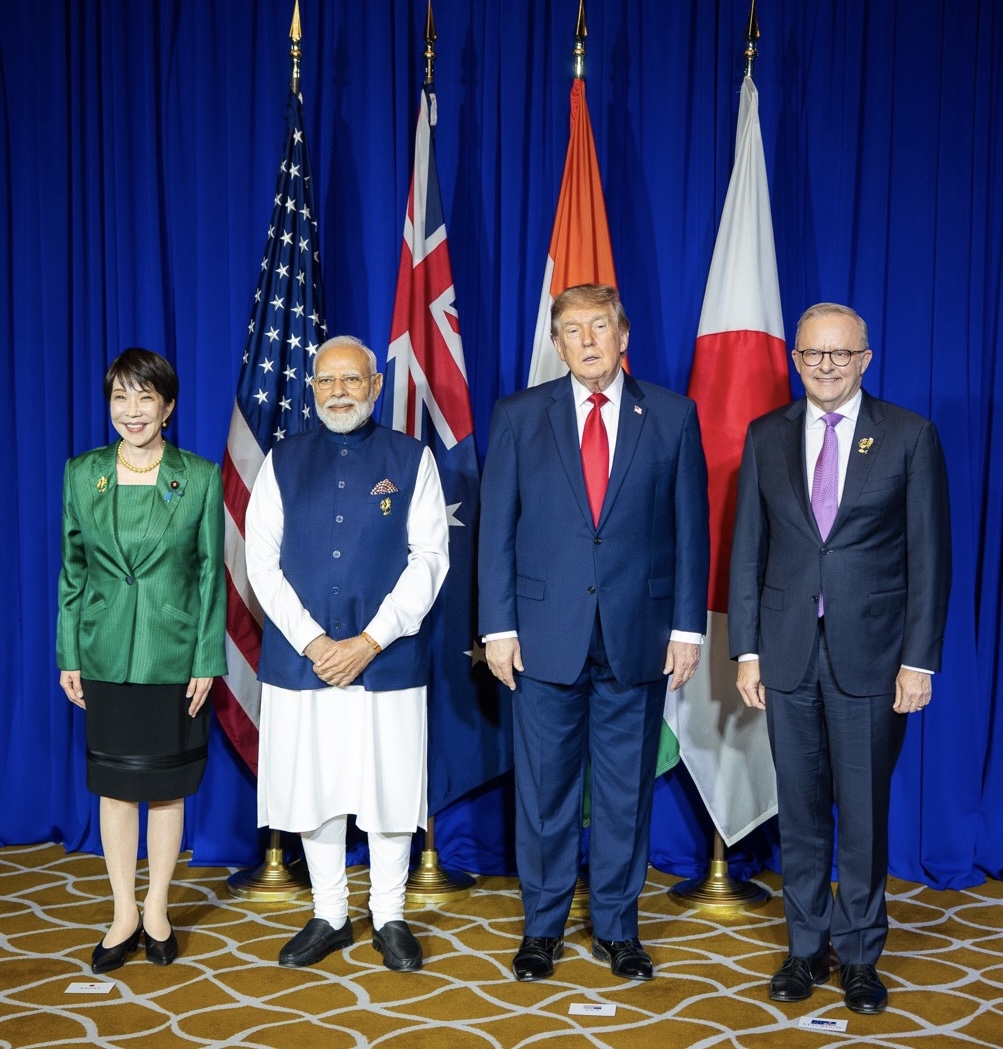
US President Donald Trump, Australian Prime Minister Anthony Albanese, Indian Prime Minister Narendra Modi and Japanese Prime Minister Sanae Takaichi met on November 17, reaffirming their commitment to a free and open Indo-Pacific amid growing regional security and economic challenges.
Marking nearly a decade since the revival of the Quad and the 10th anniversary of Japan’s late prime minister Shinzo Abe’s vision of a Free and Open Indo-Pacific, the leaders pledged stronger cooperation to maintain regional stability, protect maritime routes and strengthen economic resilience.
The joint statement expressed opposition to unilateral attempts to change the regional status quo through force or coercion, while raising concerns over economic pressure, including arbitrary export restrictions.
A key outcome was the announcement of the inaugural Quad Business Leaders’ Forum, scheduled for early 2027. The forum will bring together business executives, government representatives and policy experts to promote commercial partnerships, investment and closer private-sector cooperation among the four countries.
Maritime security emerged as another major priority, with the leaders announcing the Indo-Pacific Maritime Surveillance Collaboration to improve information sharing and maritime domain awareness.
Under the initiative, Quad countries plan to conduct their first maritime exercise involving their respective P-8 and P-3C patrol aircraft in 2027, strengthening their ability to monitor regional waters and improve maritime security cooperation.
The leaders also endorsed the Super Intelligence Accelerator, designed to coordinate funding, technical assistance and access to trusted artificial intelligence technologies across the Indo-Pacific.
Infrastructure and energy security featured prominently, with Australia expanding its contribution to the Quad Partnership for Cable Connectivity and Resilience to include electricity cables. The leaders also welcomed upcoming undersea cable projects in the Indian Ocean aimed at improving communications and regional connectivity.
Recognising the growing threat of cyberattacks, the four countries announced enhanced cybersecurity cooperation to promote a more secure and resilient digital environment.
Counterterrorism was also reaffirmed as a shared priority, with the leaders condemning terrorism and violent extremism in all forms, including cross-border terrorism, and pledging stronger cooperation against the threats.
The summit underscored the Quad’s evolution beyond a security-focused grouping into a broader strategic partnership encompassing technology, trade, infrastructure, energy and disaster response.
Importantly, the leaders reaffirmed their support for ASEAN centrality and unity, signalling that the Quad intends to strengthen regional cooperation while recognising the central role of Southeast Asian institutions in shaping the Indo-Pacific’s future.
The Manila summit therefore represents an effort by the four democracies to translate their shared strategic vision into practical initiatives, combining maritime surveillance, technological development, economic partnerships and infrastructure investment to reinforce regional stability and prosperity.